

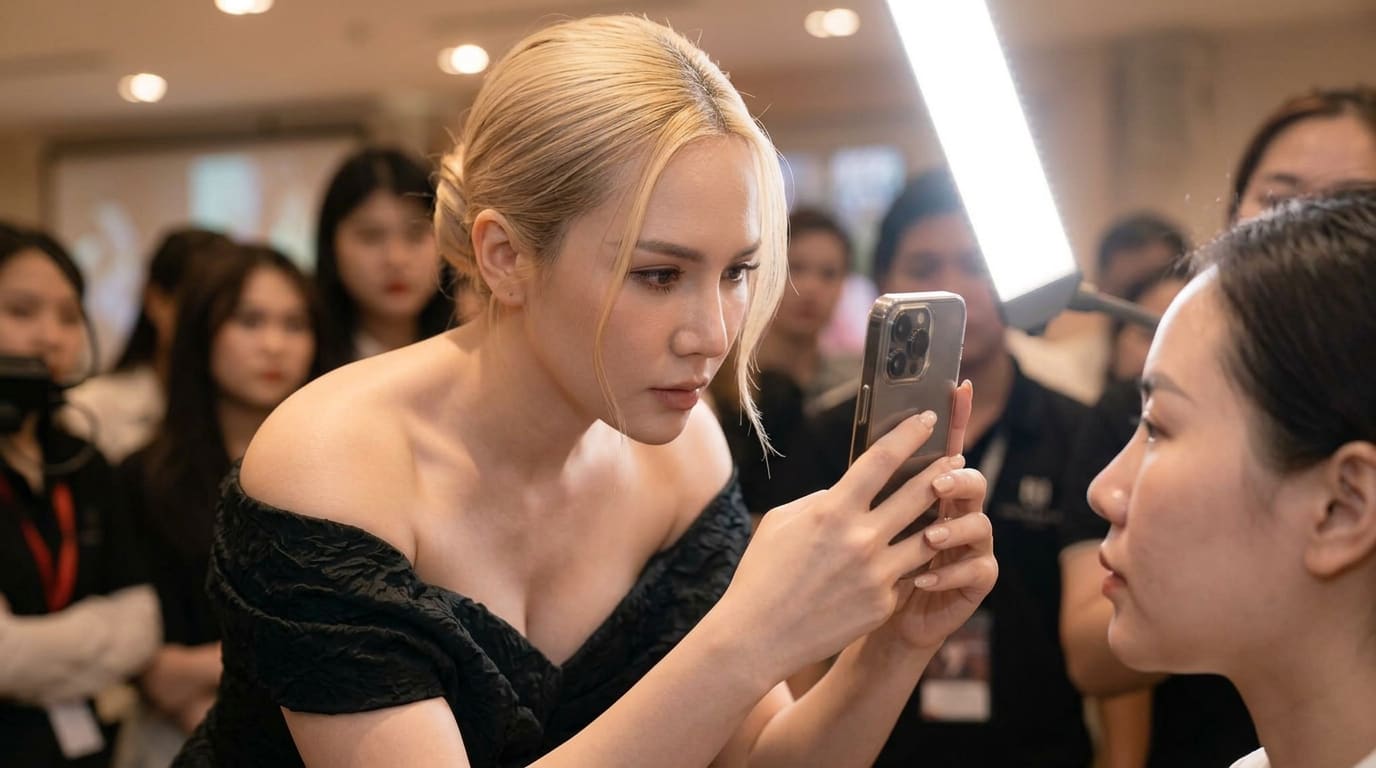
Most people researching a treatment won't consider a provider without them. But the same photos that build trust can just as easily break it. One inconsistent angle, one edited-too-hard result, and the whole gallery reads as staged. Getting this right isn't about better editing; it's about four disciplines: how you shoot, how you get permission, how you post, and how you turn it into ads without losing your account.
The Discipline of a Consistent Frame
Inconsistency is the most common mistake in beauty portfolios, and it has nothing to do with skill. When the before and after are shot under different light, from a different angle, or with a different expression, the viewer's brain reads "staged", even when the work itself is excellent.
Fix the lighting first. A ring light, or two placed on either side of the face, gives you the same result every time. Natural light, by contrast, shifts with the hour and the weather. Lock in your angle and distance too: straight-on or a slight three-quarter turn, same crop, same tilt, same gaze in both frames, against a plain background that doesn't distract from the work.
The Honesty of the Healed Result
Here's the discipline that protects your reputation more than any other. With PMU and microblading, the fresh result isn't the real result. Colour sits far darker right after the procedure, and the skin passes through redness, scabbing, and a "ghosting" phase before the true colour resurfaces weeks later.
Photograph every stage for your own records, but market the healed one, taken at the touch-up appointment, six to eight weeks out. A caption like "healed results after 6 weeks" sets honest expectations and signals you're an educator, not a hype account. Keep editing restrained: calming redness is fair, smoothing away all texture until the result looks unreal isn't.
The Quiet Confidence of Asking Permission
Any photo showing a client's face is personal data, and in the EU you need their consent to publish it, both under German image-rights law and the GDPR. Verbal consent is technically possible, but the burden of proving it always falls on you, so written consent is the professional standard: specific about where the images will appear, freely given, and revocable at any time.
The conversation doesn't have to be awkward if the timing is right. Ask about "before" photos at the end of the consultation, and about "after" photos while the client is still in the chair admiring the result, when they're happiest. Frame it as an invitation, not a request, and always offer a face-cropped or anonymous option.
Posting for the Algorithm You Actually Have
A single side-by-side image is no longer the format that performs. Carousels are the engagement engine: each swipe adds watch time, and Instagram keeps re-showing unfinished carousels, which is why they consistently out-perform single images. Reels are the discovery engine, built to reach people who don't already follow you.
Build your transformation as a carousel (a hook, the before, the healed after, a process detail, a call to action) or as a Reel with a clean before-and-after transition. Write keyword-rich, specific captions rather than relying on broad hashtags, and post consistently. For PMU specifically, keep the framing educational rather than dramatic.
Turning Proof Into Paid Growth, Compliantly
This is where permanent makeup artists most often get caught off guard. Meta's advertising exemption for before-and-after transformation content explicitly excludes permanent procedures. PMU and microblading fall under "micropigmentation", a restricted cosmetic category that must be targeted to people 18 and older, and Meta's policy is blunt that ads can't use before-and-afters to imply an idealized result.
The safer path is leading with education and real client stories rather than problem-and-fix drama: a genuine testimonial or healed-result walkthrough converts well and reads as proof, not a promise. Keep copy benefit-led, set your audience to 18+, and reserve your boldest transformation creative for non-permanent work like lash extensions and brow lamination, where you have far more room to work with.